
Devon Wildlife Trust Himalayan balsam was introduced as a garden plant in 1839, but soon escaped and became widely naturalised along riverbanks and ditches, especially close to towns. It is fast-growing and spreads quickly, invading wet habitat at the expense of other, native flowers. Its explosive seed pods aid its spread by sending the seeds into the river, causing further dispersal downstream.
Our largest annual plant, it flowers from July to October.
How to identify
Himalayan balsam has large, pink flowers shaped like a bonnet; these are followed by hanging, green seed pods.
https://www.devonwildlifetrust.org/wildlife-explorer/wildflowers/himalayan-balsam
This species is listed on Schedule 9 of the Wildlife and Countryside Act in England and Wales therefore, it is also an offence to plant or otherwise cause to grow these species in the wild.
Devonshire Association The Botany Section was founded in 1908 to promote the study and enjoyment of Devon’s wild plants, including bryophytes (mosses), lichens and fungi.
https://devonassoc.org.uk/organisation/sections/botany-section/
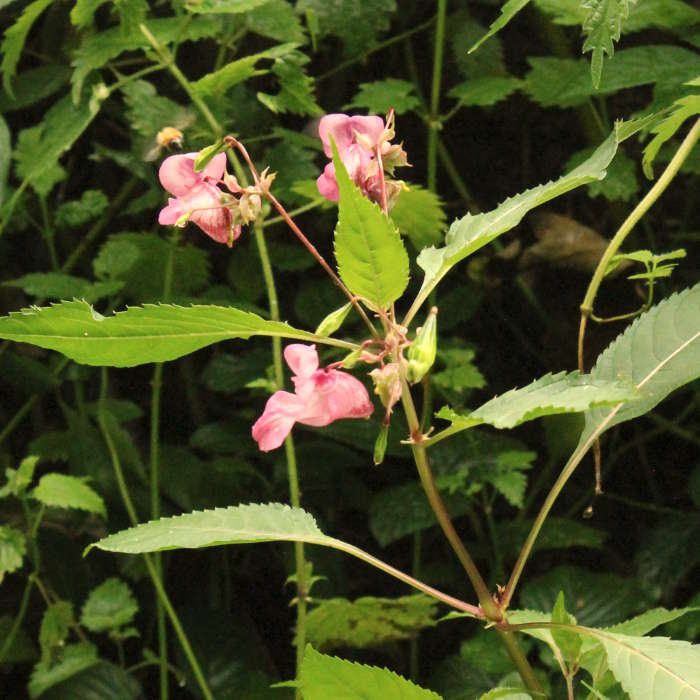
Himalayan Balsam at the bottom of Rock Hill, Chulmleigh (Photo: Grant Sherman 7th September 2020)
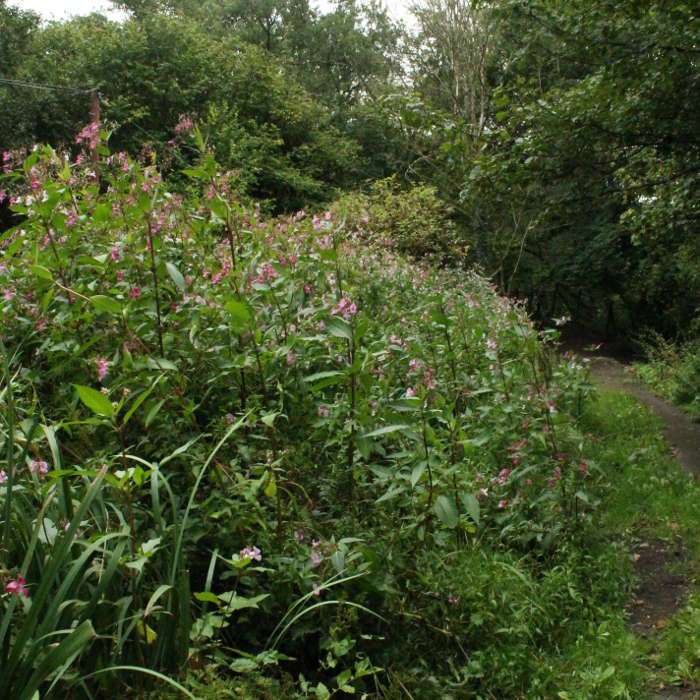
Himalayan Balsam at the bottom of Rock Hill, Chulmleigh (Photo: Grant Sherman 7th September 2020)
Plantlife A non-native invasive plant.
The largest annual plant in Britain, growing up to 2.5m high from seed in a single season. Himalayan balsam spreads quickly as it can project its seeds up to four metres. Many seeds drop into the water and contaminate land and riverbanks downstream, but the explosive nature of its seed release means it can spread upstream too.
It has large 'policeman's helmet' pink-purple flowers. Leaves have small red teeth at the edge and are in whorls of 3 or opposite. The stem is reddish.
Removing Himalayan balsam
Indian balsam needs dealing with before it sets seed. If control is undertaken early enough to prevent flowering (and if this is achieved before seed has set) then eradication is possible in two or three years. We recommend that the plants, which are shallow-rooted, should be pulled out and disposed of by composting carefully, or by burning if seeds are present. If this is done on a regular basis and the plant is not allowed to set seed, it will eventually die out. Regular strimming of larger areas is also an option, as long as it is done often enough to prevent flowering.
https://www.plantlife.org.uk/uk/discover-wild-plants-nature/plant-fungi-species/himalayan-balsam
Royal Horticultural Society Himalayan balsam (Impatiens glandulifera) is a relative of the busy Lizzie, but reaches well over head height, and is a major weed problem, especially on riverbanks and waste land, but can also invade gardens. It grows rapidly and spreads quickly, smothering other vegetation as it goes.
https://www.rhs.org.uk/advice/profile?pid=480
National Biodiveristy Network The shape of its flower has given Himalayan balsam its nickname policeman's helmet. As the name indicates, it is native to the Himalayas. It was imported to Europe as a decorative plant and has managed to adapt well in the wild. Too well for some people. Himalayan balsam has become an invasive weed in places, thanks to its aggressive means of distribution. When disturbed, the ripe seed pods burst open, scattering the seeds up to 7 meters away. This plant grows best in damp soil and therefore found in massive numbers along river banks.
https://species.nbnatlas.org/species/NBNSYS0000003189
Himalayan Balsam Wales Himalayan balsam is an introduced annual naturalised along riverbanks and ditches. It prefers moist soils but will grow anywhere. Himalayan balsam grows up to 3 m tall and is reputed to be the tallest annual plant found in the UK. A native of the Western Himalaya, it was introduced in 1839 and is now recorded throughout Britain. It grows rapidly, spreads easily, out-competes other vegetation and readily colonises new areas. Himalayan balsam is said to be relatively shade tolerant. When the plants die down in winter they leave large bare areas that are sensitive to erosion.
The information on these pages has been pulled together by non-experts, through extensive web searches and limited consultation with experts. We would recommend you also look elsewhere for further information, possibly not covered on these pages.
If you feel you could contribute, to make the site better, please do. We aim to make this as useful as possible for people to go out an make a difference locally, and we need all the help we can get. Please contact the site manager if you have contributions or questions.
https://himalayanbalsamwales.co.uk/
Wikipedia Impatiens glandulifera is a large annual plant native to the Himalayas. Via human introduction it is now present across much of the Northern Hemisphere and is considered an invasive species in many areas. Uprooting or cutting the plants is an effective means of control.
https://en.wikipedia.org/wiki/Impatiens_glandulifera



