
Devon Wildlife Trust Floating in lifeless trees, growing from thin air, it's easy to see how people in pastimes thought Mistletoe was magical. In fact, Mistletoe is a parasite and gets most of its food from its host tree - it especially likes apple, lime and Hawthorn trees. Mistletoe berries are a favourite of birds such as Blackcaps: they eat the fat-rich pith, but leave the seed attached to the branch, accidentally spreading the seeds and making it possible for a new plant to take root.
How to Identify
Mistletoe is an evergreen, but is best seen during the winter months (November to February) when great balls of it hang from the bare branches of host trees. Look for the familiar, white sticky berries (poisonous to humans) and the branching stems with small, oval leaves.
https://www.devonwildlifetrust.org/wildlife-explorer/wildflowers/mistletoe
Woodland Trust Romantic, parasitic and poisonous, mistletoe loves broadleaf trees and provides an important habitat for woodland wildlife. Its leathery green leaves offer welcome colour among bare winter branches when much else is dormant.
Mistletoe is a small semi-parasitic evergreen shrub which forms large spherical balls up to 1m wide in the tops of trees. Mistletoe leaves, stems and berries are all poisonous.
Look for it in the canopy of trees; it is commonly found in apple, lime and poplar but has also been recorded on blackthorn, hawthorn, rowan and willow. Mistletoe can produce some of its own food via photosynthesis but takes minerals and water from the host tree.
The mistletoe’s leaves are green all year round, but are more visible in the winter once the other trees have lost their leaves. The white berries appear from around October until May.
https://www.woodlandtrust.org.uk/trees-woods-and-wildlife/plants/wild-flowers/mistletoe/
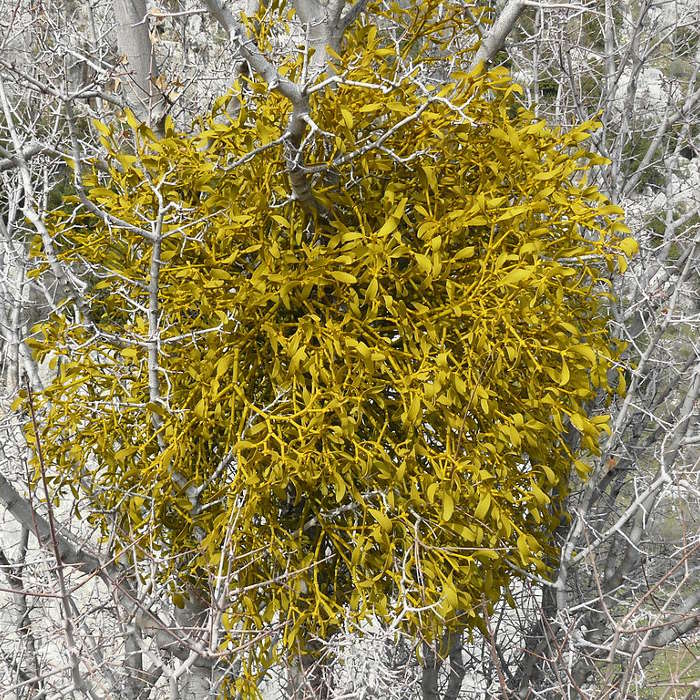
https://commons.wikimedia.org/wiki/File:Mistleltoe_in_Lebanon.JPG
Devonshire Association The Botany Section was founded in 1908 to promote the study and enjoyment of Devon’s wild plants, including bryophytes (mosses), lichens and fungi.
https://devonassoc.org.uk/organisation/sections/botany-section/
"The beams in this, as in all old farm kitchens, have many ancient hand-forged iron nails and crooks driven into them, from which various articles are hung, such as dried hams, spare Kirsmas pudd’ns, a variety of dried ‘arbs (herbs) tied up in muslin bags, which the housewife uses for seasoning or for medicinal purposes, an old-fashioned brass and hornen lantern, and, at Kirsmas taime, bunches of mistletoe “vor the bwoys to kiss the maidens under”. It was from one of these beams, too, that the neck, or miniature sheaf of corn, was hung until replaced by a fresh one the following year after harvest, so long as the old custom of “Crying the neck” was kept up."
https://devonassoc.org.uk/devoninfo/the-old-devon-farm-house-part-ii-1922/
Plantlife From kissing traditions at Christmas to ancient fertility rites, mistletoe has long been regarded as a magical plant.
It is often associated with the ancient Druids, whose reverence of the plant during the winter solstice was described by Pliny and Caesar. Perhaps it was the sight of its pearly white berries growing apparently rootless, high above the ground, in the largely dead months of winter. Like holly and ivy - also revered - mistletoe appears to be in its prime when other wild flowers have gone.
Mistletoe colonies are vital for six species of insect that live nowhere else. It is the County flower of Herefordshire and is often harvested as a winter crop from their cider and perry orchards.
https://www.plantlife.org.uk/uk/discover-wild-plants-nature/plant-fungi-species/mistletoe
Royal Horticultural Society Mistletoe (Viscum album) is an evergreen plant that is smothered in white berries from winter to spring. It grows in the branches of trees, such as hawthorn, apple, poplar, lime and conifers.
Mistletoe is a parasitic plant that lives off the nutrients and water from a host tree. Although it is parasitic, it will not kill the host tree but can weaken it.
The berries are often spread by birds from one tree to another, and this is how the large rounded clumps of mistletoe form in tree branches.
The most common host tree in the UK is apple, but poplar and lime are also frequent hosts. It is mainly found in the south and west midlands in the UK, with particularly large populations in Herefordshire.
How to grow your own mistletoe Although mistletoe is spread naturally by birds, it is possible to grow it yourself;
- Harvest berries from a tree in March or April. Make sure you choose a tree that is similar to the type of tree in your own garden that you wish to establish the mistletoe on.
- Discard any crushed berries and do not use berries from sprigs used as Christmas decorations. These will not germinate as they are generally harvested when immature.
- Choose a branch 10cm (4in) or more in girth on a tree that is 15-years-old or more. Ideally this should be fairly high up, so the developing plant receives plenty of light.
- Find a natural crevice in the bark or make a shallow cut to create a small flap.
- Remove the seeds from the fleshy berries and insert them into the crevice or under the flap.
- Finish by covering with hessian to protect the seeds from birds.
- To ensure greater success, sow quite a few seeds at each site as only one in ten seeds germinate, and both male and female plants are needed for berries to form.
The branch will swell as the mistletoe develops, but don’t expect quick results; plants can take five years or more to reach berrying size.
https://www.rhs.org.uk/advice/profile?pid=134
National Biodiveristy Network Viscum album
https://species.nbnatlas.org/species/NBNSYS0000003624
Wikipedia Viscum album is a species of mistletoe in the family Santalaceae, commonly known as European mistletoe, common mistletoe or simply as mistletoe (Old English mistle). It is native to Europe and western and southern Asia.
Viscum album is a hemiparasite on several species of trees, from which it draws water and nutrients. It has a significant role in European mythology, legends, and customs. In modern times, it is commonly featured in Christmas decoration and symbology.
It is a hemi-parasitic shrub, which grows on the stems of other trees. It has stems 30–100 centimetres (12–39 in) long with dichotomous branching. The leaves are in opposite pairs, strap-shaped, entire, leathery textured, 2–8 centimetres (0.79–3.15 in) long, 0.8–2.5 centimetres (0.31–0.98 in) broad and are a yellowish-green in colour. This species is dioecious and the insect-pollinated flowers are inconspicuous, yellowish-green, 2–3 millimetres (0.079–0.118 in) diameter. The fruit is a white or yellow berry containing one (very rarely several) seed embedded in the very sticky, glutinous fruit pulp.
It is commonly found in the crowns of broad-leaved trees, particularly apple, lime (linden), hawthorn and poplar.
https://en.wikipedia.org/wiki/Viscum_album


