Devon Wildlife Trust The climbing stems, glossy leaves and round clusters of berries of ivy are a familiar sight across town and country. Growing up trees and old walls, carpeting the ground, and forming thick bushes if left unchecked, this creeping plant is not actually a parasite, as many might think, but only gets support from its host. This host might be a house, shed or a tree in woodland, but none of them will suffer for it. The yellow-green flowers of ivy are a great source of nectar for autumn insects, such as hornets, honeybees and red admiral butterflies. Ivy also provides roosting sites for bats and birds, and a home for hibernating insects.
How to Identify
Ivy is an evergreen and its glossy, oval leaves, with pale veins, can be seen throughout the year. Between September and November, look out for the yellow-green flowers that grow in rounded clusters; these are followed by black berries.
https://www.devonwildlifetrust.org/wildlife-explorer/wildflowers/ivy
Woodland Trust Clingy, luscious, misunderstood. Ivy has long been accused of strangling trees, but it doesn’t harm the tree at all, and even supports at least 50 species of wildlife.
Ivy is an evergreen, woody climber which can grow to a height of 30m. It has two different forms – juvenile and mature. It has climbing stems with specialised hairs which help it stick to surfaces as it climbs. Mature forms can be self-supporting.
Ivy grows well throughout the UK and can be found in many habitats, including woodland, scrub, wasteland and on isolated trees. It is tolerant of shade and survives in all but the most dry, waterlogged or acidic soils.
It's an evergreen plant so leaves can be seen at any time of the year. It flowers in September to November and its fruits ripen in November to January.
https://www.woodlandtrust.org.uk/trees-woods-and-wildlife/plants/wild-flowers/ivy/
Devonshire Association The Botany Section was founded in 1908 to promote the study and enjoyment of Devon’s wild plants, including bryophytes (mosses), lichens and fungi.
https://devonassoc.org.uk/organisation/sections/botany-section/
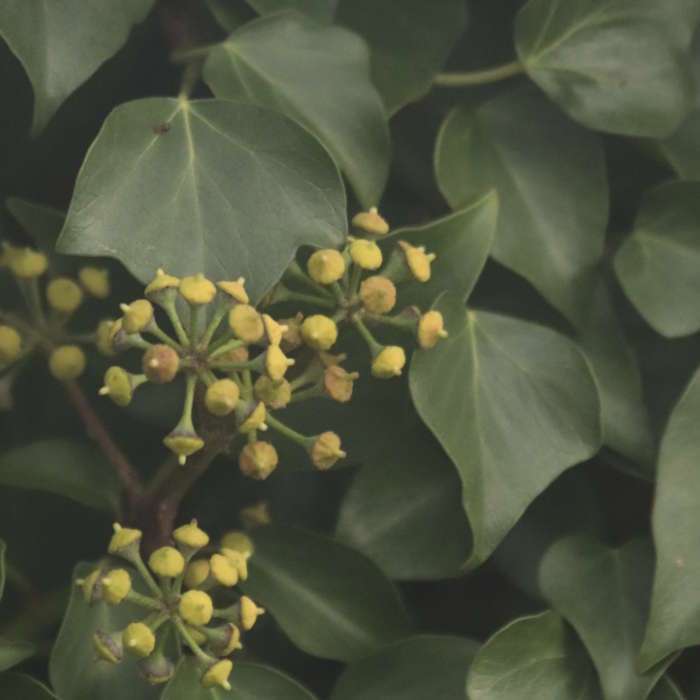
Ivy in our garden in Chulmleigh (Photo by Grant Sherman)
Plantlife A evergreen woody climber, commonly seen on old walls and tree trunks.
Ivy is often found carpeting the ground or growing up walls and trees. Its flowers bloom in an umbrella-like spread. In fact the term for such a bloom - an 'umbel' - derives from the same source as umbrella - umbra, the Latin word for shade. Leaves are dark green glossy above, paler below. On flowering shoots leaves are pointed oval.
Ivy is, of course, celebrated with holly in the Christmas Carol of the same name. Its symbolism, however, predates Christianity. As evergreen species both holly and ivy were seen as especially powerful during the leafless days of winter. Sprigs were said to ward off evil spirits and inside the home kept the house goblins at bay. Of the two, ivy - shapely and curvaceous - was said to represent the feminine as compared to the spiky, angular masculinity of holly.
Local names include Bentwood, Bindwood, Hibbin, Ivin, Ivery and the enchanting Love-Stone used in Leicestershire.
Sadly it is no longer used for Christmas decoration. As Grigson (1958) remarks, 'A pity, because you do not have to purchase Ivy at an outrageous cost from the greengrocer, and you can fix it easily around the house, where the umbels, with or without berries, make delicious starry patterns against the wall'.
In the Highlands and Islands it has been used as protection, to keep evil away from milk, butter and the animals. Circlets of ivy alone, or ivy plaited with Rowan and honeysuckle were hung over the lintels of byres and put under milk vessels.
https://www.plantlife.org.uk/uk/discover-wild-plants-nature/plant-fungi-species/ivy
Royal Horticultural Society Hedera are evergreen climbing shrubs clinging by aerial roots. Clusters of small yellow-green flowers are followed by usually black berries. Foliage of flowering shoots is often less deeply lobed than that of the sterile, climbing shoots
H. helix is a vigorous, self-clinging climber with three- to five-lobed, glossy, evergreen leaves, often with pale green veins, and some reddish or bronzy colours in autumn. Mature plants produce bushy, non-clinging branches with diamond-shaped leaves, and small, nectar-rich, greenish-yellow flowers in clusters of rounded heads in autumn, followed by black berries in winter
https://www.rhs.org.uk/Plants/43091/i-Hedera-helix-i/Details
National Biodiveristy Network Hedera helix
https://species.nbnatlas.org/species/NHMSYS0021118909
Wikipedia Hedera helix, the common ivy, English ivy, European ivy, or just ivy, is a species of flowering plant in the family Araliaceae, native to most of Europe and western Asia. A rampant, clinging evergreen vine, it is a familiar sight in gardens, waste spaces, on walls, tree trunks and in wild areas across its native habitat. As a result of its hardy nature, and its tendency to grow readily without human assistance, English ivy has attained popularity as an ornamental plant, and escaped plants have led to naturalisations outside its native range.