
Devon Wildlife Trust Selfheal can be seen creeping through the short turf of a grassland or the uncut grass of a woodland clearing or roadside verge; it can even pop up in lawns that haven't been treated with chemicals. Its clusters of violet flowers appear from June to October and provide a nectar source for bees and wasps.
How to identify
Selfheal is a low-growing, perennial herb with paired, oval leaves and bluish or violet flowers that appear in dense, oblong clusters on the top of its stems. Its purple-tinged seed head remains after flowering.
https://www.devonwildlifetrust.org/wildlife-explorer/wildflowers/selfheal
Devonshire Association The Botany Section was founded in 1908 to promote the study and enjoyment of Devon’s wild plants, including bryophytes (mosses), lichens and fungi.
https://devonassoc.org.uk/organisation/sections/botany-section/
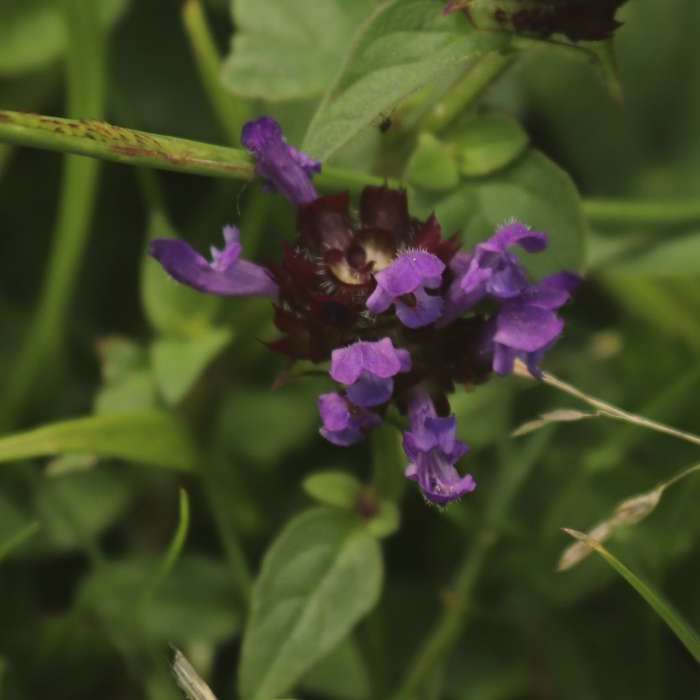
Selfheal in our lawn, Chulmleigh (Photo: Grant Sherman)
Plantlife A quirky violet-blue wildflower with a squarish, compact head on short erect stems.
Its leaves are hairy, stalked, scarcely toothed, often purple tinged and oval to diamond-shaped. The plant often forms a mat.
https://www.plantlife.org.uk/uk/discover-wild-plants-nature/plant-fungi-species/selfheal
Royal Horticultural Society Prunella are semi-evergreen perennials of spreading habit, the prostrate stems rooting at the nodes, with dense, short spikes of small, 2-lipped flowers
https://www.rhs.org.uk/Plants/13944/i-Prunella-vulgaris-i/Details
Wikipedia Prunella vulgaris (known as common self-heal, heal-all, woundwort, heart-of-the-earth, carpenter's herb, brownwort and blue curls) is a herbaceous plant in the genus Prunella.
Self-heal is edible: the young leaves and stems can be eaten raw in salads; the plant in whole can be boiled and eaten as a potherb; and the aerial parts of the plant can be powdered and brewed in a cold infusion to make a beverage.
https://en.wikipedia.org/wiki/Prunella_vulgaris


