
Woodland Trust Industrious, delicate, colourful. The spindle is at its loveliest in autumn when its leaves turn russet and its pink and orange fruits ripen. Wildlife loves its leaves and fruit, and aphids flock to it, bringing with them an array of their predators.
Spindle is a deciduous native tree, and mature trees grow to 9m and can live for more than 100 years. The bark and twigs are deep green, becoming darker with age, and have light brown, corky markings. Twigs are thin and straight.
Identified in winter by: the vivid pink fruits which have bright orange seeds. Buds and twigs are angular and green.
Devon Wildlife Trust
https://www.devonwildlifetrust.org/
Devonshire Association The Botany Section was founded in 1908 to promote the study and enjoyment of Devon’s wild plants, including bryophytes (mosses), lichens and fungi.
https://devonassoc.org.uk/organisation/sections/botany-section/
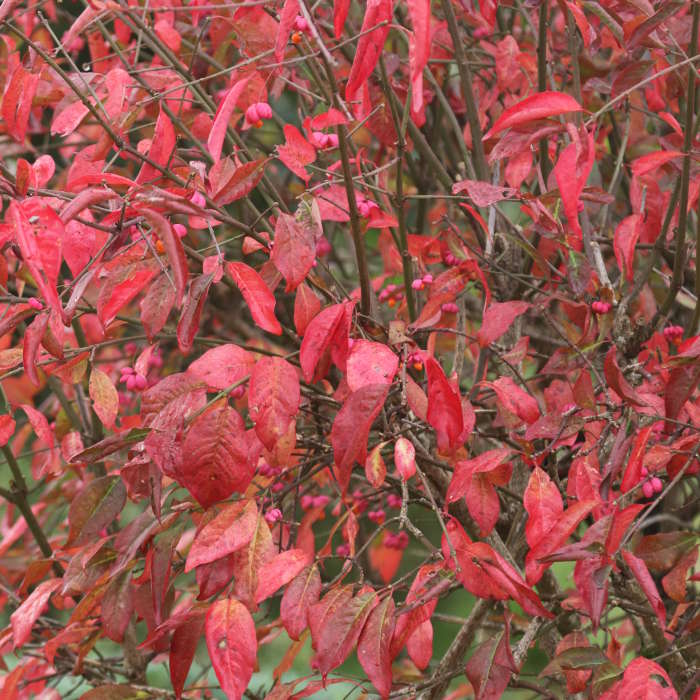
Spindle in our garden, Chulmleigh (Photo: Grant Sherman 9th October 2020)
Plantlife Wild flowers , plants and fungi are the life support for all our wildlife and their colour and character light up our landscapes. But without our help , this priceless natural heritage is in danger of being lost.
From the open spaces of our nature reserves to the corridors of government , we work nationally and internationally to raise their profile, celebrate their beauty, and to protect their future.
https://www.plantlife.org.uk/uk
Royal Horticultural Society E. europaeus is a spreading deciduous shrub to 3m, with narrowly ovate leaves turning yellow or red in autumn, and panicles of small yellow flowers followed by 4-lobed red fruits which split to reveal orange seeds.
https://www.rhs.org.uk/Plants/6977/i-Euonymus-europaeus-i/Details
National Biodiveristy Network Euonymus europaeus
https://species.nbnatlas.org/species/NBNSYS0000003195
Wikipedia Euonymus europaeus, the spindle, European spindle, or common spindle, is a species of flowering plant in the family Celastraceae, native to much of Europe, where it inhabits the edges of forest, hedges and gentle slopes, tending to thrive on nutrient-rich, chalky and salt-poor soils. It is a deciduous shrub or small tree. Other names include fusoria, fusanum, ananbeam, shemshad rasmi (Iran), while it may have given its name to the ancient Greek settlement of Euonymeia.
https://en.wikipedia.org/wiki/Euonymus_europaeus


