
Devon Wildlife Trust Beavers are Britain’s largest rodent, belonging to the same group as rats, mice and voles. Thanks to their flat tail and webbed feet these amazing animals are suited to life both on land and in the water. These clever engineers will build dams to give themselves access to deep pools of water and transform their surroundings by cutting down small trees for food and for building supplies. Afterall, no beaver home is complete without their very own private swimming pool. Beavers live with their family, usually around five individuals which includes adults, kits and yearlings. Beavers sleep throughout the day, preferring to come out during sunrise and sunset.
How to Identify
As large as a Labrador dog, but with shorter legs, the European beaver is robust and heavily built. Two distinctive features are a broad, flat tail, covered with scales, and webbed feet. It has small eyes and ears, and light brown fur.
https://www.devonwildlifetrust.org/wildlife-explorer/mammals/beaver
Beavers are very charismatic animals and not that difficult to see if you spend enough time by the river in the right areas. They are nocturnal for much of the year, but during the light summer evenings they can be seen during daylight hours. They are resident in the lower reaches of the River Otter in areas well covered by the public footpath network, and if you spend enough time on these paths during the summer evenings between May and September you stand a good chance of seeing them, as well as otters, kingfishers, dippers, etc.
One of the best areas is currently around Otterton village where the footpaths go north, south and west from the main river bridge, but this can change.
https://www.devonwildlifetrust.org/what-we-do/our-projects/river-otter-beaver-trial
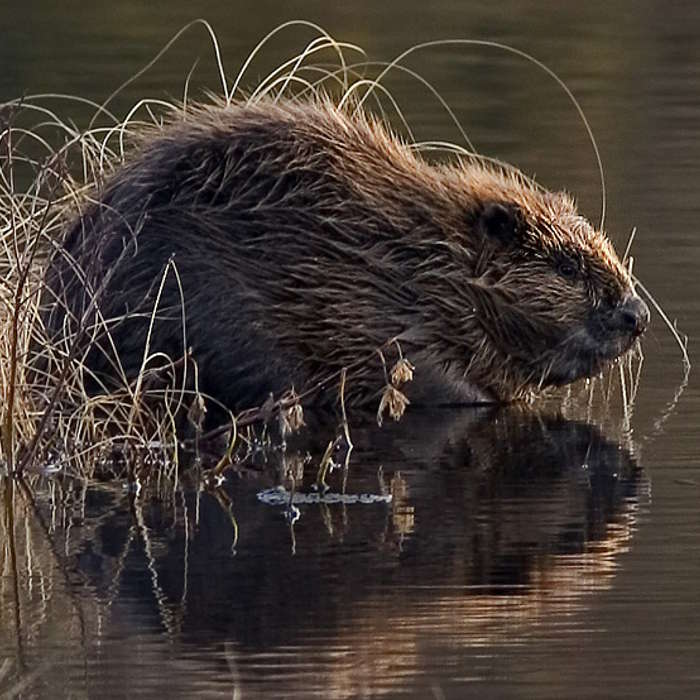
A European Beaver in Norway. Date 13 July 2006 Author Per Harald Olsen
https://commons.wikimedia.org/wiki/File:Beaver_pho34.jpg
University of Exeter The River Otter Beaver Trial was a five-year project (2015-2020) to investigate the effects of a wild-living population of beavers on the River Otter. Beavers were released under a licence issued to the Devon Wildlife Trust – the first to be issued in England – and a detailed programme of research was undertaken through a Science and Evidence Forum chaired by Professor Richard Brazier here at the University of Exeter.
The Science and Evidence Report summarises the scientific findings from this five-year trial and is available to download.
https://www.exeter.ac.uk/creww/research/beavertrial/
National Biodiversity Network Eurasian beavers communicate mainly through chemical communication. Not only do they use castoreum to mark territory, but they also use their oil glands to distinguish between males and females. Eurasian beavers also use postures, tail slapping, and vocalizations. Vocalizations include whining calls, whistling, and hissing. Tail slapping is used when they are frightened or upset.
https://species.nbnatlas.org/species/NBNSYS0000005107
Wikipedia The Eurasian beaver (Castor fiber) or European beaver is a beaver species that was once widespread in Eurasia, but was hunted to near-extinction for both its fur and castoreum. At the turn of the 20th century, only about 1,200 beavers survived in eight relict populations in Europe and Asia. It has been reintroduced to much of its former range, and now occurs from Spain, Central Europe, Great Britain and Scandinavia to a few regions in China and Mongolia. It is listed as least concern on the IUCN Red List, as it recovered well in most of Europe. It is extinct in Portugal, Moldova, and Turkey.


