
Mars is the fourth planet from the Sun and the second-smallest planet in the Solar System, being larger than only Mercury. In English, Mars carries the name of the Roman god of war and is often referred to as the "Red Planet". The latter refers to the effect of the iron oxide prevalent on Mars's surface, which gives it a reddish appearance distinctive among the astronomical bodies visible to the naked eye. Mars is a terrestrial planet with a thin atmosphere, with surface features reminiscent of the impact craters of the Moon and the valleys, deserts and polar ice caps of Earth.
The point at which Mars's geocentric longitude is 180° different from the Sun's is known as opposition, which is near the time of closest approach to Earth. The distance at close approach varies between about 54 and 103 million km (34 and 64 million mi) due to the planets' elliptical orbits, which causes comparable variation in angular size. The last Mars opposition occurred on 27 July 2018 at a distance of about 58 million km (36 million mi). The next Mars opposition occurs on 13 October 2020, at a distance of about 63 million km (39 million mi). The average time between the successive oppositions of Mars, its synodic period, is 780 days; but the number of days between the dates of successive oppositions can range from 764 to 812.
As Mars approaches opposition it begins a period of retrograde motion, which makes it appear to move backwards in a looping motion relative to the background stars. The duration of this retrograde motion is about 72 days.
https://en.wikipedia.org/wiki/Mars
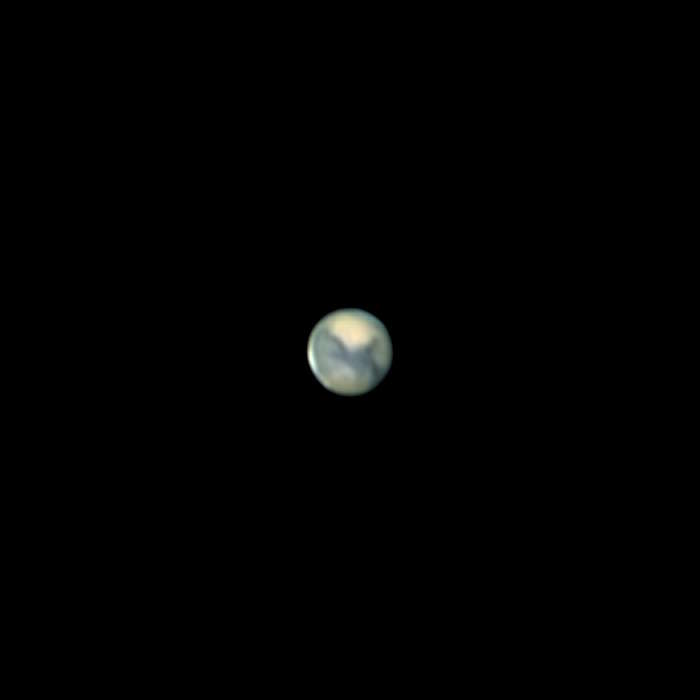
Image of Mars from 23rd October 2005. Stacked images from a webcam on a 102mm Maksutov–Cassegrain telescope (Grant Sherman)



