A classic Norman motte and bailey castle, founded soon after the Conquest to overawe the Saxon town. A later stone shell-keep crowns its steep mound, giving sweeping views across the town rooftops to the River Dart.
Climb to the top of the keep to enjoy stunning views over the town of Totnes and across to the River Dart. Or enjoy a picnic in the peaceful grounds under the shelter of age old trees - there is plenty of space for families to relax on a summers day. Within easy walking distance of the town, the castle is an ideal addition to any day out in South Devon and you can combine the visit with one to nearby Dartmouth and Berry Pomeroy Castles which are just a short drive away.
https://www.english-heritage.org.uk/visit/places/totnes-castle/
Totnes Castle Castle Street, Totnes TQ9 5NU
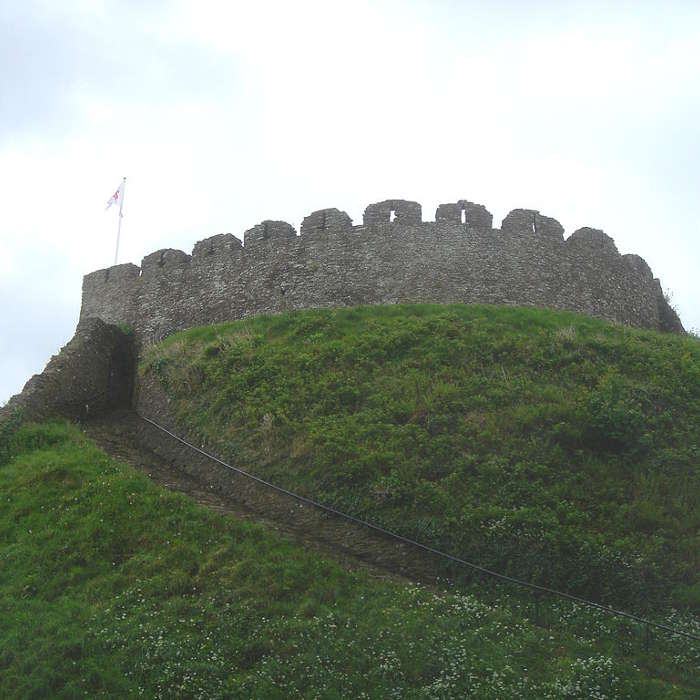
https://commons.wikimedia.org/wiki/File:Totnes_Castle2.JPG
Historic England A motte and bailey castle, presumably with timber fortifications, was constructed by Judhael of Totnes shortly after the Conquest. It occupied the north-east corner of the Anglo-saxon burgh. The earliest shell-keep, built by Reginald de Braose circa 1219, was extensively rebuilt together with the rest of the castle by Baron Zouche in 1326. The castle was later owned by the Edgecombes of Cothele and the Seymour family, by whom it was placed in the guardianship of the Ministry of Works in 1947. The main function of Totnes castle was to act as a centre for the manorial courts under the constable, and as a base for the administration of the family estates. The earliest remains, apart from the motte and bailey earthworks, are masonry footings on the top of the motte of an Cll or C12 square, timber tower. The surviving upstanding masonry is mostly of C14 date and comprises a circular masonry shell-keep and sections of the bailey curtain wall. Keep of Devonion limestone rubble with red sandstone dressings and battered external face. Crenellated battlements with merlons pierced for loom; approached by 2 stairways in the thickness of the wall. Garderobe chamber also within the thickness of the curtain and projecting beyond the line of the wall; lit by pair of crossed loops. Bailey curtain-wall of pitched limestone rubble. The hall and other domestic buildings which formerly stood in the bailey no longer survive. Flanking the entrance to the site are 2 granite pillars possibly taken from the Exchange built in 1616 and pulled down in 1878. Scheduled Ancient Monument.
https://historicengland.org.uk/listing/the-list/list-entry/1168856
Wikipedia Totnes Castle is one of the best preserved examples of a Norman motte and bailey castle in England. It is situated in the town of Totnes on the River Dart in Devon. The surviving stone keep and curtain wall date from around the 14th century. From after the Norman Conquest of 1066 it was the caput of the Feudal barony of Totnes.
The castle occupies a commanding position atop a large hill above the town, and guards the approach to three valleys.
The first castle on this site is believed to have been built by the Breton Juhel of Totnes (also known as Judhael) who was one of William the Conqueror's lieutenants. The feudal barony of Totnes was granted to him in 1068, and in order to cement his control over the area he constructed a fortification and founded Totnes Priory within the town. This first construction probably consisted of a wooden palisade and tower. On the death of King William I, Juhel lost his lands, possibly as a result of his support for the Rebellion of 1088. The feudal barony of Totnes was then granted to Roger de Nonant, whose descendants appear to have held it for the next three generations. Following this it came into the possession of William de Braose, 3rd Lord of Bramber, who is probably responsible for constructing the first stone shell keep and walls on the site.
By 1326, the castle had fallen into ruin and was under the control the de la Zouch family. During this period a royal order was made for the repair of the fortifications. As a result, the castle was re-fortified with a new shell keep, using Devonian limestone and red sandstone, a stable was constructed and a constable appointed. Following the Wars of the Roses it once again fell into disrepair. The castle was occupied for a period during the Civil War but saw no notable action.
Since 1984 the castle has been under the stewardship of English Heritage. The castle is a scheduled monument and a Grade I listed building.